

> _“You can't compare non-living because you can't experience it, being by definition the absence of conscious experience.”_
I think that's evidently false. ie, you _have_ to be able to compare existence with non-existence. If you throw your hands in the air and refuse to compare, you end up in very strange places, ethically.
Someone who commits suicide is doing that comparison (for themselves).
A couple who ends the pregnancy of a fetus who is known to carry an important incurable disease is doing that comparison (for someone else).
A family authorising euthanasia for a relative in a vegetative state is doing that comparison (for someone else).
The whole field of [population ethics](https://en.wikipedia.org/wiki/Population_ethics) needs that comparison to be feasible, at least in certain cases. Public health policy, too.
Yeah, that too. I suspect many people understand that _not existing_ is painless, and may actually better than living. But they are prey to status quo bias and to primal instincts for survival, or they fear the actual difficulty and messiness of ending their lives.
I identify as a #consequentialist and a (negative) #utilitarian, I suspect that existence is _probably_ not worth it because of the asymmetry of #qualia, and yet I have no intention of ending my own life (and I think that's rational). Why?
When we're #children we don't really understand what suffering is, and we don't even know that living is a choice. So we live.
#Teens and young adults famously tend to get closer to one of two poles: either they're disappointed, miserable, or lost (some of those do end their lives), or they are having a great time: they're at their prime, disease and pain are unknown to them, they discover pleasures, etc (those are happy to live).
We #adults are usually so entangled in relationships by this stage of life that even if/when we decided that non-existence beat existence _for us_, we wouldn't want to cause more suffering to those who love us and those who depend on us. So we (usually) live.
Second, even though I think that life is mostly #suffering, including human lives, that is just a generalisation, an average. Some lives one can expect to be miserable in all likelihood, while others are set to be as good as possible — even a net positive.
I live in one of the most prosperous countries on earth. I earn well above the average salary here, and so does my wife. We are relatively healthy and free of major health conditions. No history of relevant communicable diseases in our families, no major mental health issues, addiction, or tendency towards violence. We eat reasonably well, we are calm, we don't spend recklessly.
I expect our children to have lives that are better than the average human being's. Perhaps even lives worth living, after all.
First of all, I'm not _that_ convinced that antinatalism is true. I still have major doubts or objections. At the same time, my instinct is to want to have children.
I don't think that is hypocrisy. I usually want to be as rational and detached as possible. But when reasons seem weak or risky, and intuition plus tradition plus social norms plus advice from those close to me point somewhat strongly in the opposite direction, the gut can override the brain, and I think that's indeed reasonable.
Lately I've become quite sympathetic to #antinatalism.
And yet I have two kids, and if I were to start over again I think I would decide to have kids again.
How's that possible?
(thread)
I think we'll have to look at some numbers. Otherwise it's personal impression vs personal impression.
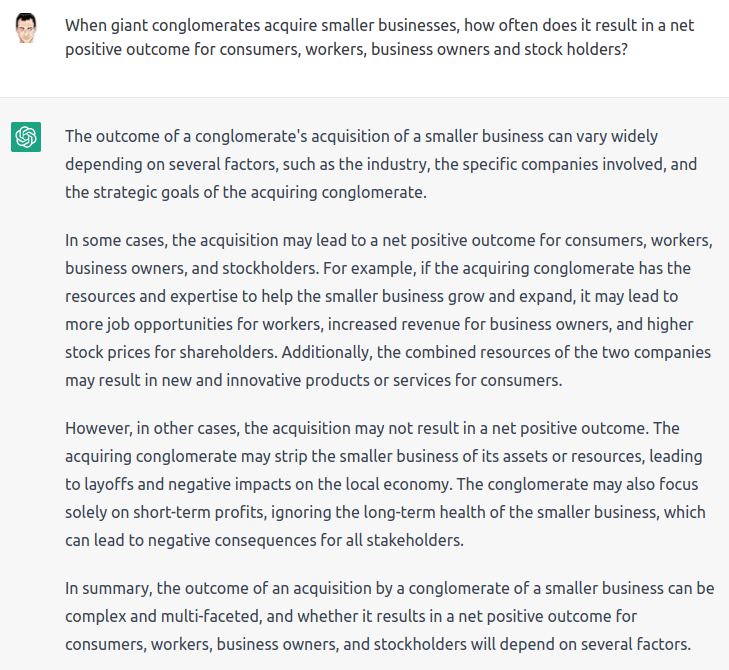
In any case: even if, say, 75% of all mergers or takeovers of small companies by huge companies result in a net negative for society, and 25% in a net positive, why alienate clients, consumers, workers and small business owners by accusing all those in favour of such operations of being predatory or selfish?
…or unless you own a bit of that giant conglomerate (ie, you are one of hundreds of thousands of stock holders) and see your retirement plan improve a little bit after the merger (that's hundreds of thousands of saving plans improving a little bit).
…or unless you're a client of the smaller business who would suffer disruption, stock shortages or lack of customer support unless the conglomerate rescues the company.
…or unless you're a user who would improve their user experience when the smaller business becomes part of a larger conglomerate and streamlines its products.
…or unless you're a worker at the smaller business who gains in stability, working conditions, and/or income by becoming an employee of a much robust organisation.
…or unless you're a consumer who would benefit from a marginal reduction in prices as a consequence of increased productivity after consolidation.
…
Dependence on a power socket would be a weakness in very, very unstable times for sure.
wrt environmental friendliness, it's difficult to tell. Even with conservative estimates, I think my car beats a petrol car in Spain with our power generation mix and my usage pattern. If/when the grid gets smarter and the power mix here gets greener, my opting for an EV should be a net positive all things considered.
Then there's also the extra comfort (quieter, non-stinky, instant torque), the “privileges” (entering the city centre, special lanes, parking for free and with no time limit in congested areas) and the example/inspiration/proof-of-concept for myself and for others.
With 95-octane #petrol at 1.70 €/ℓ,
and us paying 0,14 €/KW×h at home,
we're saving ~1,200 €/year in fuel.
Assuming we paid a €10K premium for a 100% #EV (over a comparable petrol-powered #car), we'll break even in little more than 8 years.
Throw in some likely savings in vehicle taxes, maintenance, and parking meters, and it's more like 7 years until we recoup the extra investment.
We bought it one year ago, so we'll start saving actual #money in 2029.
tripu
boosted

I wish more people understood that "I want the computer to generate a natural language text that sounds like a plausible answer to a question about x" and "I want the computer to answer a question about x" are two very different problems.
The plugin ecosystem for [templating engines in Express](https://expressjs.com/en/resources/template-engines.html) is (still) larger than [in Koa](https://github.com/koajs/koa/wiki#templating).
In particular, for #Handlebars, there seem to be just 3 in #Koa, and all quite outdated (last updated in 2016, 2017 and 2017).
Alternatives to #Handlebars:
[**Mustache**](https://mustache.github.io/): zero dependencies, and dead simple. Too simple? Being logic-less means that conditionals and loops are pre-cooked, and that may limit options.
[**Pug**](https://pugjs.org/): main advantage and main drawback: its concise but idiosyncratic syntax, similar to that of #Slim — which I know and have used in the past, but is too much of a departure from #HTML.
[**EJS**](https://ejs.co/): similar to Handlebars, simple but apparently versatile. Documentation isn't great.
 #JS #JavaScript
  #Node.js #Node
Alternatives to #Express:
[**Koa**](https://koajs.com/), which can either [replace or complement](https://github.com/koajs/koa/blob/master/docs/faq.md) both Express and [Connect](https://github.com/senchalabs/connect).
[**Fastify**](https://www.fastify.io/), which looks straightforward and very similar to Express. Plugin for templating (supporting Handlebars, Mustache, Pug and EJS): [@fastify/view](https://github.com/fastify/point-of-view).
[**NestJS**](https://nestjs.com/), which seems too convoluted and probably redundant since it works on top of either Express or Fastify (?).
[**Meteor**](https://www.meteor.com/): more of a platform. No tutorial for vanilla JS (only for React, Vue, etc), and not oriented towards SSR.
I'll probably go for #Koa or #Fastify.
#JS #JavaScript #Node.js #Node
What should I use instead of #Express and #Handlebars for a web application in Node.js in 2023? Can someone summarise pros and cons of the most popular alternatives? I see way too many…
tripu
boosted

Oh, man. This comic — from 1993 — could NOT be more relevant today. As usual, Bill Watterson hits it out of the park.

