

🎓 Doc Freemo  🇳🇱
@freemo@qoto.org
🇳🇱
@freemo@qoto.org
- UFoI Member
- http://UFoI.org/u/freemo/
- Website
- http://JeffreyFreeman.me
- Gitlab
- https://git.qoto.org/freemo
Admin
Jeffrey Phillips Freeman
Innovator & Entrepreneur in Machine Learning, Evolutionary Computing & Big Data. Avid SCUBA diver, Open-source developer, HAM radio operator, astrophotographer, and anything nerdy.
Born and raised in Philadelphia, PA, USA, currently living in Utrecht, Netherlands, USA, and Thailand. Was also living in Israel, but left.
Pronouns: Sir / Mister
(Above pronouns are not intended to mock, i will respect any persons pronouns and only wish pronouns to show respect be used with me as well. These are called neopronouns, see an example of the word "frog" used as a neopronoun here: http://tinyurl.com/44hhej89 )
A proud member of the Penobscot Native American tribe, as well as a Mayflower passenger descendant. I sometimes post about my genealogical history.
My stance on various issues:
Education: Free to PhD, tax paid
Abortion: Protected, tax paid, limited time-frame
Welfare: Yes, no one should starve
UBI: No, use welfare
Racism: is real
Guns: Shall not be infringed
LGBT+/minorities: Support
Pronouns: Will respect
Trump: Moron, evil
Biden: Senile, racist
Police: ACAB
Drugs: Fully legal, no prescriptions needed
GPG/PGP Fingerprint: 8B23 64CD 2403 6DCB 7531 01D0 052D DA8E 0506 CBCE
Joined Jul 2018
🎓 Doc Freemo 🇳🇱
boosted
🇳🇱
boosted

This person wrote their thesis on 18th century hand grenades. I might be in the wrong field.
==Invictus==
> Out of the night that covers me,
> Black as the Pit from pole to pole,
> I thank whatever gods may be
> For my unconquerable soul.
>
> In the fell clutch of circumstance
> I have not winced nor cried aloud.
> Under the bludgeonings of chance
> My head is bloody, but unbowed.
>
> Beyond this place of wrath and tears
> Looms but the Horror of the shade,
> And yet the menace of the years
> Finds, and shall find, me unafraid.
>
> It matters not how strait the gate,
> How charged with punishments the scroll.
> I am the master of my fate:
> I am the captain of my soul.
--William Ernest Henley
"It should never be forgotten for a single moment that the central and essential work of the Magician is the attainment of the Knowledge and Conversation of the Holy Guardian Angel. Once he has achieved this he must of course be left entirely in the hands of that Angel, who can be invariably and inevitably relied upon to lead him to the further great step—crossing of the Abyss and the attainment of the grade of Master of the Temple." -- Aleister Crowly
🎓 Doc Freemo 🇳🇱
boosted
🇳🇱
boosted
@robryk There is a lot of debate as to what is safest honestly and much of it is a matter of opinion. We have multiple algorithms and people seem to have varying opinions on what is best.
Consider the same dives on a buhman deco algorithm (the earlier numbers I gave was using the VPM model). With the ideal gases your deco has now become closer to 3 hours, but with just air your deco is 8 hours on a buhlman model.
So using air you are kinda in this area where one algo tells you you are going to die and the other says youll be fine. The margins between algos are much less when using ideal gases.
While this doesnt clearly explain WHY there is a greater risk it does sort of show that there is a big risk there.
Now is spending that 8 hours of deco more risky than doing it with proper gases and spending 1/4 the time in deco, probably. You can follow an algorithm perfectly and still get decompression sickness and die, the risk is always there. The more you push the limits the more risk there is. A 400ft dive is always going to be more risk than a 100ft dive, and similarly a five where you are using gases that slow your ability to off gas are inherently riskier too.
It isnt about the time int he water though. I actually double my last stop at 20 feet when i dive even thought he deco algo says im good to surface. But thats because I'm spending more time off gasing.
Now if i am to speculate as to why longer dives on air is more dangerous I think the best explanation would be saturation of deep tissue compartments. Deep tissue has to go through several layers of tissue to off gas. So what happens is that while at first your shallow tissues are more saturated that moderately deep tissues as you surface your moderately deep tissues diffuse to both deeper and more shallow tissue, and they must off cas before the deep tissue will start off gasing. The longer it takes to deco the more the shallow saturation will leak into deeper tissue before reversing and off gasing into the shallower tissue. This takes a much longer time, and more time means more possible for error in the algorithm if your metabolism isnt as expected. All this is adding risk.
🎓 Doc Freemo 🇳🇱
boosted
🇳🇱
boosted

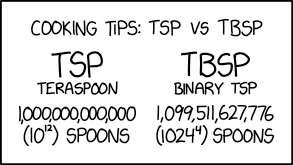
#2526 Tsp vs Tbsp
It's like one teraspoon / when all you need is a kilonife
🎓 Doc Freemo 🇳🇱
boosted
🇳🇱
boosted
@robryk can't, but not simply due to deco constraints (though deco would be much longer and less safe). The main reason would be nitrogen narcosis. You are limited on air by convention to about 100 feet/30 meters because any deeper and the nitrogen narcosis would be too disorienting and thus dangerous. I myself have a natural tolerance to nitrogen narcosis so I can safely handle about 160 feet on air before it becomes an issue for me, but that is already well below safety margins.
The next limit on air is oxygen toxicity. You'd be limited to about 220 feet / 67 meters on air before the oxygen would risk giving you a seizure. So while you can replace the nitrogen with either more oxygen or helium to offset the nitrogen narcosis youll still hit a limit on depth with air due to the oxygen toxicity.
The deco itself is of course a third limiting factor for doing air deco.
All that said you can go slightly into decompression limits with air and still safely get out if I wanted to do a 100 foot dive for longer than no-deco allows. But I'd be very limited doing deco on air.
🎓 Doc Freemo 🇳🇱
boosted
🇳🇱
boosted

@freemo Can't, or that deco would be infeasibly long?
A friend of mine asked me why DNA and RNA are acids. I am **not** an expert in chemistry but I did study the basics of organic chem and do dabble a bit so I wanted to share the answer here.
Simple answer: Anything that lowers pH is an acid, RNA and DNA lower pH, therefore it is an acid.
Complex answer:
Nucleic Acids are called acids because, well, they lower pH, as anything that is an acid would. pH is, in simplistic terms, the concentration (logarithmicly) of H+ ions in a solution.
A unrelated side note with acids that dont directly donate a H+, your Lewis Acids, they still increase H+ in an aqueous solution because it effects the balance of H+ and OH- dissociation of the water itself. As such the H+ measure is still accurate. However Nucleic acids are not a Lewis Acid, they are a Bronstead-Lowry acid, which means they directly can dissociate and provide the H+ ion directly in an aqueous solution. But I'll get to that.
The individual parts of any molecule can be either acidic and basic, but a molecule overall will usually be one or the other depending on which dominates, RNA is no different, there are three major components to RNA, I attached a picture to show them. The components are a phosphate group, a sugar, and a nitrogenous base (the part that encodes data, your citosine and guanine and shit). Here is the cool part, the word base when talking about the "bases" of a strand is specifically chosen as the the word because they are themselves bases (on their own they would raise pH). Similarly the phosphor group, is also acidic, this should be obvious by its similarity to phosphoric acid. It is a proton donor for the same reason phosphoric acid is a proton donor.
So the only question remaining is why does the acidic phosphor group dominate over the Nitrogenous Base? Well for starters the the phosphate group has a pkA of near 0 , the Nitrogenous Base has a pkB of around 9.8 (depends on the base), so already the phosphate group is going to dissociate more readily than the Nitrogenous Group. However RNA strands are actually far more acidic than the individual Nucleotides that compose them happen to be. The reason for this is that RNA folds back in on itself with the bases associating with each other much like two halves of a DNA strand would. This causes the bases to be on the interior of the molecule while leaving the phosphate groups all around the outside. Since the bases are not exposed to the aqueous solution they do not dissociate as readily as they otherwise would while the phosphate groups are free to dissociate. Thus the RNA exhibits significant acidic properties.
By the way the acidic nature of RNA and DNA is intentional and functionally important. It means that the pH of the solution can be adjusted to effect the charge on the nucleotides and thus move it around. In a neutral pH solution the phosphate groups will have a negative charge. This results in the phosphates pushing each other away. This in turn can cause them to line up on opposite sides with their bases facing each other as well as help to straighten out a strand's backbone.
#DNA #RNA #Chemistry #Organic Chem #OChem #OrganicChemistry #Science #STEM @Science
🎓 Doc Freemo 🇳🇱
boosted
🇳🇱
boosted

@freemo no. But she will touch your wallet. Lol
Woman: Do you want to get married some day?
Me: Is marriage that thing where a woman lets you touch her boobies whenever you want? If so then yes.
So apparently due to covid the SCUBA on the island is limited to air, they dont have 100% and 50% O2 available right now. That really sucks, that means I cant do a deco dive!
🎓 Doc Freemo 🇳🇱
boosted
🇳🇱
boosted

A useful article to help us promote Mastodon
What is Mastodon and why should I use it?
https://laurakalbag.com/what-is-mastodon-and-why-should-i-use-it/
🎓 Doc Freemo 🇳🇱
boosted
🇳🇱
boosted

 This is Mur
@freemo
Make it Middle Endian
(Half of the bytes are read front way the other half backwards)
🎓 Doc Freemo 🇳🇱
boosted
🇳🇱
boosted
@freemo @tetrislife @QOTO
And here we stumble upon the question of revolutionary change and legacy compatibility again 
🎓 Doc Freemo 🇳🇱
boosted
🇳🇱
boosted

@QOTO I appreciate the variety of services qoto.org opens up (I appreciate nixnet, snopyta, ouvaton, disroot, frama* too). Becaise I also appreciate all-in-one solutions like Hubzilla and public hubs, I was wondering if the one log-in can be used for all of qoto.org's services.
Here is what a relatively shallow (170 feet / 52 meter) decompression dive looks like. Link of dive video along with dive profile statistics to get an idea of the depth along the way.

One of my first dives: Lobster, and Pipe Fish (uncut) https://video.qoto.org/videos/watch/a94a1e8e-be4d-4355-803b-d541805b119d
Some of you have been curious about my Cave diving expiernce. Here is a video of my first certified cave dive. I also attached a link to the dive profile, this one was a shallow dive, I'll try to post a deep-dive next.
My first cave dive following my cave certification https://video.qoto.org/videos/watch/adaa54df-809a-402d-84af-6d08c7906682
🎓 Doc Freemo 🇳🇱
boosted
🇳🇱
boosted



My uncle just finished 1.6 kg, 700 pages long dictionary of Northern Sami, a language spoken by around 20,000 speakers.
Sami are an indigenous people who have inhabited large parts of Northern Europe spanning from Russia to Norway for millenniums.
He has dedicated his life to advocate for their rights and preserve their languages and culture. This book is a major contribution in an effort to ensure that this ancient language will be passed on to future generations.

Man I forgot how expensive scuba was, 1,200$ just for a damn flash light, lol.
- UFoI Member
- http://UFoI.org/u/freemo/
- Website
- http://JeffreyFreeman.me
- Gitlab
- https://git.qoto.org/freemo
Admin
Jeffrey Phillips Freeman
Innovator & Entrepreneur in Machine Learning, Evolutionary Computing & Big Data. Avid SCUBA diver, Open-source developer, HAM radio operator, astrophotographer, and anything nerdy.
Born and raised in Philadelphia, PA, USA, currently living in Utrecht, Netherlands, USA, and Thailand. Was also living in Israel, but left.
Pronouns: Sir / Mister
(Above pronouns are not intended to mock, i will respect any persons pronouns and only wish pronouns to show respect be used with me as well. These are called neopronouns, see an example of the word "frog" used as a neopronoun here: http://tinyurl.com/44hhej89 )
A proud member of the Penobscot Native American tribe, as well as a Mayflower passenger descendant. I sometimes post about my genealogical history.
My stance on various issues:
Education: Free to PhD, tax paid
Abortion: Protected, tax paid, limited time-frame
Welfare: Yes, no one should starve
UBI: No, use welfare
Racism: is real
Guns: Shall not be infringed
LGBT+/minorities: Support
Pronouns: Will respect
Trump: Moron, evil
Biden: Senile, racist
Police: ACAB
Drugs: Fully legal, no prescriptions needed
GPG/PGP Fingerprint: 8B23 64CD 2403 6DCB 7531 01D0 052D DA8E 0506 CBCE
Joined Jul 2018
